What is Refractive Error
Refractive error is a problem with focusing light accurately on the retina due to the shape of the eye and/or cornea, causing blurred vision.
The eye normally creates a clear image because the cornea and lens bend (refract) incoming light rays to focus them on the retina. The shape of the cornea is fixed, but the lens changes shape to focus on objects at various distances from the eye. By becoming more rounded, the lens allows near objects to be focused. By becoming flatter, the lens allows objects farther away to be focused. When the cornea and lens cannot focus the image of an object sharply on the retina, it is called a refractive error.
Causes of Refractive Error
The lens and cornea may not bend light rays to focus them on the retina correctly for several reasons.
Nearsightedness (myopia)
It occurs when the eyeball is too long for the refractive power of the cornea and lens. Because of the corneal curvature and relatively long size, light is focused in front of (rather than directly on) the retina, and the person has trouble clearly seeing distant objects. In children, nearsightedness frequently increases until children stop growing.
Farsightedness (hyperopia)
It occurs in some people when the eyeball is too short for the refractive power of the cornea and lens. Because of the relatively short size, light is focused behind the retina. Children and young adults who are mildly farsighted may be able to see clearly if their lens is flexible enough to properly refocus light on the retina. However, with aging, the lens stiffens. Thus, as farsighted adults age, seeing near objects clearly becomes more difficult and seeing distant objects also becomes more difficult. Blurring of nearby objects is worse in dim light
Astigmatism
It is an imperfectly shaped cornea or lens (not perfectly round or spherical), which may cause objects to appear blurred at any distance.
Presbyopia
It occurs as people age. As people reach their early or mid-40s, the lens becomes increasingly stiff. The lens does not change shape easily, so it cannot focus on nearby objects. Thus, as adults age, they often notice difficulty seeing nearby objects.
Aphakia
It is the absence of a lens resulting from a birth defect, eye injury, or eye surgery for removal of a cataract. If a person has had a lens removed to treat cataracts but has not had a lens implant, objects look blurred at any distance.
Symptoms of Refractive Error
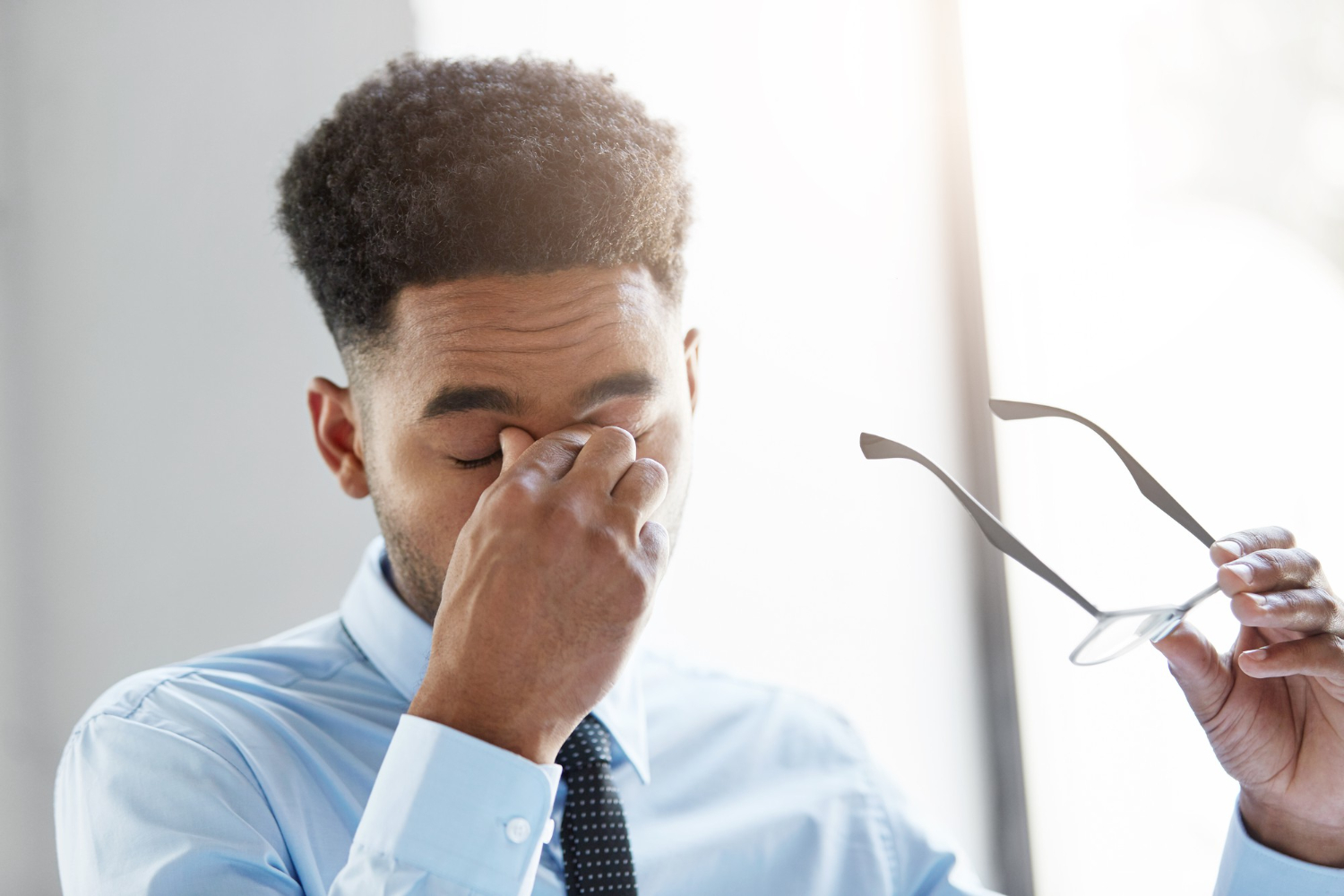
A person who has a refractive error may notice that vision is blurred for distant objects, near objects, or both. For example, a child who becomes nearsighted may have difficulty seeing the chalkboard in school. People may sometimes have headaches caused by squinting or frowning. In children, frowning and squinting when reading and excessive blinking or rubbing of the eyes may indicate the child has a refractive error. Refractive error can contribute to eye strain (eye discomfort and fatigue), which occurs when a person stares for a long time trying to read or while working at a computer; the eyes can dry out and become itchy, red, or irritated, and vision seems temporarily blurred.
Diagnosis of Refractive Error
Eye examination, including measurement of visual acuity.
Everyone should have regular eye examination by an ophthalmologist (a medical doctor who specializes in the evaluation and treatment [surgical and nonsurgical] of eye disorders) or an optometrist (a health care practitioner who specializes in the diagnosis and treatment of refractive errors). This eye examination should be repeated every 1 or 2 years. Screening children helps detect refractive errors before they interfere with learning.
During the examination, an eye chart is used to determine sharpness of vision (visual acuity). Visual acuity is measured in relation to what a person with normal (unimpaired) vision sees. For example, a person with 20/60 vision sees at 20 feet (about 6 meters) what a person with normal vision sees at 60 feet (about 18 meters). In other words, the person must be 20 feet away to read letters that a person with normal vision can read from 60 feet away.
Retinoscope can be used to measure objectively in which the person views a distant spot while the clinician changes the lenses held before the person’s eye and watches the pattern of reflection of a small light shone on the eye. Following that “objective refraction” the clinician typically shows the person lenses of progressively higher or weaker powers in a process known as subjective refraction. Cycloplegic agents are frequently used to more accurately determine the amount of refractive error, particularly in children
An automated refractor is an instrument that is sometimes used in place of retinoscopy to objectively estimate a person’s refractive error. Shack–Hartmann wavefront sensor and its inverse can also be used to characterize eye aberrations in a higher level of resolution and accuracy.
Although refractive errors usually occur in otherwise healthy eyes, testing generally also includes assessments unrelated to refractive error, such as a test of the visual fields, eye pressures, and eye movements.
Management/Treatment of Refractive Error
The management of refractive error is done post-diagnosis of the condition by either optometrist, ophthalmologists, or ophthalmic medical practitioners.
How refractive errors are treated or managed depends upon the amount and severity of the condition. Those who possess mild amounts of refractive error may elect to leave the condition uncorrected, particularly if the person is asymptomatic. For those who are symptomatic, glasses, contact lenses, refractive surgery, or a combination are typically used.
Glasses
These are the most effective ways of correcting the refractive error. However, the availability and affordability of eyeglasses can present a difficulty for people in many low-income settings of the world. Glasses also pose a challenge to children to whom they are prescribed to, due to children’s tendency to not wear them as consistently as recommended.
As mentioned earlier refractive errors are because of the improper focusing of the light in the retina. Eyeglasses work as an added lens of the eye serving to bend the light to bring it to focus on the retina. Depending on the eyeglasses, they serve many functions.
Reading glasses
These are general over-the-counter glasses which can be worn for easier reading, especially for defective vision due to aging called presbyopia.
Single vision prescription lenses
They can correct only one form of defective vision, either far-sightedness or near-sightedness.
Multifocal lenses
The multifocal lenses can correct defective vision in multiple focus, for example: near-vision as well as far-vision. This is particularly beneficial for presbyopia.
Contact lenses
Many people think contact lenses allow them to be more active or make them feel more attractive than when wearing eyeglasses. Some people think that vision is more natural with contact lenses. However, contact lenses require more care than eyeglasses and, rarely, they can damage the eye. Some people, particularly people with a tremor or people with arthritis, may have trouble handling contact lenses and placing them in their eyes.
Contact lenses provide better peripheral vision (the outer limits of the field of vision) than do eyeglasses.
Contact lenses can be made that correct for different visual problems (such as distance and close-up vision) in different parts of the lens. These are so-called bifocal or multifocal contact lenses.
Either soft or rigid (hard) contact lenses are used to correct nearsightedness and farsightedness. Soft Toric lenses (which have different curvatures molded onto the front lens surface) or rigid contact lenses can correct astigmatism, but require expert fitting.
Presbyopia can also be corrected with contact lenses. In one approach, called monovision, one eye is corrected for reading and the other is corrected for distance vision. However, some people have difficulty adjusting to monovision. Another approach is to wear a bifocal or multifocal contact lens in each eye.
Neither rigid nor soft contact lenses offer the eyes the protection against a blunt or sharp injury that eyeglasses do.
Care and complications of contact lenses
Contact lenses should be removed and cleaned every day at bedtime using a contact lens disinfecting solution. Tap water should never be used, particularly to clean soft or gas-permeable contact lenses. Hands should be washed with soap and water before handling lenses. Each lens is cleaned separately. A lens is placed in the palm of one hand, and several drops of fresh solution are dripped onto it. The fingertip of the index finger of the other hand is used to clean the lens, using a gentle back-and-forth motion on both surfaces of the lens. Another several drops of solution are then used to rinse the lens. After cleaning, all contact lenses should be disinfected, by storing them in fresh disinfectant solution in a contact lens case overnight.
After the lenses are inserted the next day, the disinfectant solution should be removed from the lens case. The lens case is then rinsed with fresh solution and placed in a cabinet or drawer and allowed to dry by leaving it open to the air. The case should not be left open on the countertop around the sink in the bathroom because tiny droplets that disperse after brushing teeth or flushing the toilet may contain microorganisms and can settle in the case and start an infection. The lens case should be replaced every 1 to 2 months
Wearing contact lenses longer than recommended or longer than the eye can tolerate can cause eye redness, watering, and light sensitivity (called contact lens overwear syndrome or contact lens overuse syndrome). Once the lenses are removed, these symptoms tend to resolve over a day or so, but symptoms that continue longer could be a sign of a more serious infection
Wearing contact lenses poses a risk of serious, vision-threatening, painful complications, including the formation of ulcers on the cornea. Corneal ulcers can be caused by bacteria, viruses, fungi, or amebae and can cause loss of vision. The risks can be greatly reduced by strictly following the eye doctor’s lens care instructions.
The risk of serious infections increases when people swim or shower while wearing their contact lenses and clean their lenses with homemade saline solution, saliva, tap water, or distilled water. Sleeping while wearing any type of contact lens also greatly increases the risk of serious infections. The risk of infection increases for every night a person sleeps in soft contact lenses. The best way to reduce the risk of infection is to not sleep in contact lenses, disinfect correctly, and not expose the contact lens to tap water. If a person has intense eye pain, excessive watering of the eye, pain with exposure to light, vision changes, or eye redness, the contact lenses should be removed immediately. If the symptoms do not resolve quickly, the person should contact an eye doctor.
Surgery
Laser in situ keratomileusis (LASIK) and photo-refractive keratectomy (PRK) are popular procedures; while use of laser epithelial keratomileusis (LASEK) is increasing. Other surgical treatments for severe myopia include insertion of implants after clear lens extraction (refractive lens exchange). Full thickness corneal graft may be a final option for patients with advanced keratoconus although currently there is interest in new techniques that involve collagen crosslinking. As with any surgical procedure complications may arise post-operatively post-operative monitoring is normally undertaken by the specialist ophthalmic surgical clinic and optometry services. Patients are usually informed pre-operatively about what to expect and where to go if they suspect complications. Any patient reporting pain and redness after surgery should be referred urgently to their ophthalmic surgeon.
Medical treatment
Atropine has believed to slow the progression of near-sightedness and is administered in combination with multifocal lenses. These, however, need further research.
Prevention
Strategies being studied to slow worsening include adjusting working conditions, increasing the time children spend outdoors, and special types of contact lenses. In children special contact lenses appear to slow worsening of nearsightedness.